
Date Log
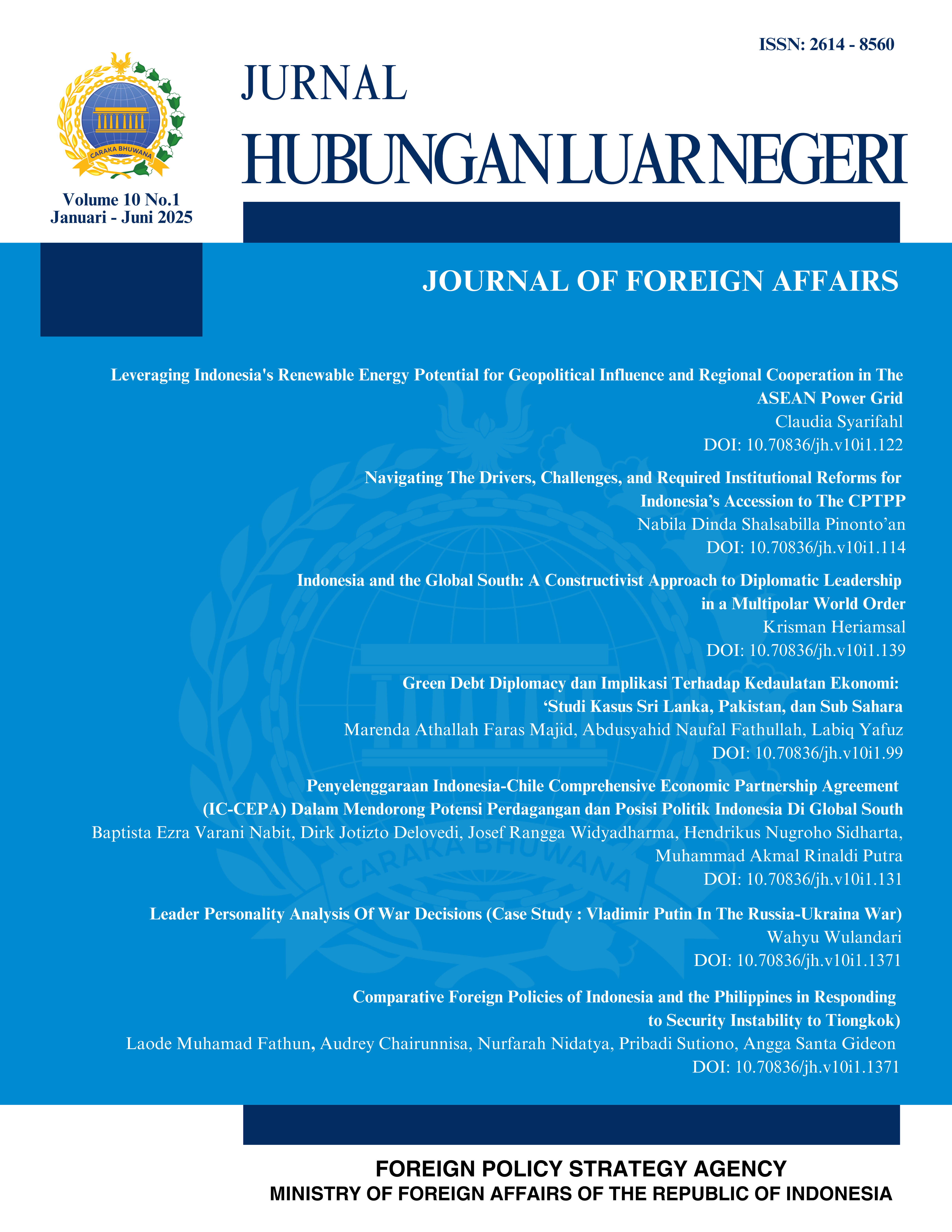
Green Debt Diplomacy dan Implikasi Terhadap Kedaulatan Ekonomi: Studi Kasus Sri Lanka, Pakistan, dan Sub Sahara

Corresponding Author(s) : Marenda Majid
JURNAL HUBUNGAN LUAR NEGERI,
Vol. 10 No. 1 (2025): Jurnal Hubungan Luar Negeri
Abstract
Kesenjangan pembiayaan iklim (green debt) yang semakin lebar di negara-negara berkembang menjadi tantangan serius dalam mencapai target pengurangan emisi dan adaptasi terhadap dampak perubahan iklim. Di tengah tekanan utang dan keterbatasan fiskal, konsep diplomasi utang hijau muncul sebagai pendekatan alternatif yang menghubungkan pelunasan utang dengan pendanaan aksi iklim. Artikel ini bertujuan untuk mengulas secara kritis bagaimana mekanisme diplomasi utang hijau diterapkan di Sri Lanka, Pakistan, dan kawasan Sub-Sahara Afrika, serta mengevaluasi efektivitasnya dalam mendukung pembangunan berkelanjutan. Penulisan dilakukan melalui pendekatan deskriptif kualitatif berbasis studi pustaka, dengan merujuk pada artikel-artikel ilmiah terkini yang terindeks Scopus. Dengan melakukan pendekatan teori modernisasi, temuan utama menunjukkan bahwa meskipun skema ini menjanjikan sebagai solusi pembiayaan inovatif, pelaksanaannya masih terbatas oleh ketimpangan kekuasaan dalam sistem global, lemahnya kapasitas fiskal negara penerima, serta minimnya komitmen negara maju dalam merealisasikan janji pendanaan iklim. Di sisi lain, mekanisme ini juga membuka peluang untuk memperkuat kontribusi nasional (NDCs) jika didukung oleh tata kelola keuangan yang lebih adil dan kolaboratif. Artikel ini merekomendasikan agar reformasi struktural dalam tata kelola utang dan penguatan posisi tawar negara berkembang menjadi agenda prioritas dalam kerangka diplomasi iklim global.
Keywords
Download Citation
Endnote/Zotero/Mendeley (RIS)BibTeX
- Abb, P. (2023) ‘All geopolitics is local: the China–Pakistan Economic Corridor amidst overlapping centre–periphery relations’, Third World Quarterly, 44(1), pp. 76–95. Available at: https://doi.org/10.1080/01436597.2022.2128329.
- Adeney, K. and Boni, F. (2024) ‘Global China and Pakistan’s federal politics: 10 years of the China–Pakistan Economic Corridor’, Commonwealth and Comparative Politics [Preprint]. Available at: https://doi.org/10.1080/14662043.2024.2354568.
- Brautigam, D. (2020) ‘A critical look at Chinese “debt-trap diplomacyâ€Â: the rise of a meme’, Area Development and Policy, 5(1), pp. 1–14. Available at: https://doi.org/10.1080/23792949.2019.1689828.
- Calinoff, J. and Gordon, D. (2020) ‘Port Investments in the Belt and Road Initiative: Is Beijing Grabbing Strategic Assets?’, Survival, 62(4), pp. 59–80. Available at: https://doi.org/10.1080/00396338.2020.1792134.
- Conteh-Morgan, E. (2021) ‘Strategies of sinoâ€Âamerican rivalry in africa: From 2000 to covidâ€Â19’, Vestnik RUDN. International Relations, 21(2), pp. 265–278. Available at: https://doi.org/10.22363/2313-0660-2021-21-2-265-278.
- DeBoom, M.J. (2020) ‘Who is afraid of “debt-trap diplomacy� Geopolitical narratives, agency and the multiscalar distribution of risk’, Area Development and Policy, 5(1), pp. 15–22. Available at: https://doi.org/10.1080/23792949.2019.1703556.
- Delina, L. (2017) ‘Multilateral development banking in a fragmented climate system: shifting priorities in energy finance at the Asian Development Bank’, International Environmental Agreements: Politics, Law and Economics, 17(1), pp. 73–88. Available at: https://doi.org/10.1007/s10784-016-9344-7.
- el-Shafei, A.W. and Metawe, M. (2022) ‘China drive toward Africa between arguments of neo-colonialism and mutual-beneficial relationship: Egypt as a case study’, Review of Economics and Political Science, 7(2), pp. 137–152. Available at: https://doi.org/10.1108/REPS-03-2021-0028.
- Finance, E.T. and Team, P. (2023) ‘The Role of Multilateral Development Banks in Closing the Climate and Energy Transition Finance Gap’, (01), pp. 1–11.
- He, A. (2020) ‘The Belt and Road Initiative: Motivations, financing, expansion and challenges of Xi’s ever-expanding strategy’, Journal of Infrastructure, Policy and Development, 4(1), pp. 139–169. Available at: https://doi.org/10.24294/jipd.v4i1.1180.
- Irandu, E.M. and Owilla, H.H. (2020) ‘The Economic Implications of Belt and Road Initiative in the Development of Railway Transport Infrastructure in Africa: The Case of the Standard Gauge Railway in Kenya’, African Review (Tanzania), 47(2), pp. 457–480. Available at: https://doi.org/10.1163/1821889X-12340027.
- Khan, Z. et al. (2020) ‘Debunking Criticism on the China-Pakistan Economic Corridor’, Chinese Economy, 53(6), pp. 477–487. Available at: https://doi.org/10.1080/10971475.2020.1792065.
- Kouwenberg, R. and Zheng, C. (2023) ‘A Review of the Global Climate Finance Literature’, Sustainability (Switzerland), 15(2). Available at: https://doi.org/10.3390/su15021255.
- Li, W. and Lu, S. (2024) ‘Assessing Structural Transformation and the Potential Impacts of Belt and Road Initiative Projects in Africa’, European Journal of Development Research, 36(3), pp. 548–570. Available at: https://doi.org/10.1057/s41287-024-00624-1.
- Lubieniecka, E.R. (2014) ‘Chinese Engagement in Sub-Saharan Africa: Can the Beijing Consensus be Explained Under World-Systems Analysis?’, Fudan Journal of the Humanities and Social Sciences, 7(3), pp. 433–450. Available at: https://doi.org/10.1007/s40647-014-0023-1.
- Lubinga, M.H. and Mazenda, A. (2024) ‘Empirical Analysis of the Effect of Institutional Governance Indicators on Climate Financing’, Economies, 12(2), pp. 1–19. Available at: https://doi.org/10.3390/economies12020029.
- Maulida, H. (2022) ‘Dinamika Islam dalam kebijakan luar negeri Indonesia pemerintahan Joko Widodo periode 2014-2022 ( studi kasus dukungan Indonesia terhadap proses perdamaian di Afghanistan )’, 2022.
- Mlambo, C. (2022) ‘China in Africa: An Examination of the Impact of China’s Loans on Growth in Selected African States’, Economies, 10(7). Available at: https://doi.org/10.3390/economies10070154.
- Mohan, P.S. (2023) ‘Financing needs to achieve Nationally Determined Contributions under the Paris Agreement in Caribbean Small Island Developing States’, Mitigation and Adaptation Strategies for Global Change, 28(5), pp. 1–24. Available at: https://doi.org/10.1007/s11027-023-10062-9.
- Ogwang, T. and Vanclay, F. (2021) ‘Resource-financed infrastructure: Thoughts on four chinese-financed projects in uganda’, Sustainability (Switzerland), 13(6). Available at: https://doi.org/10.3390/su13063259.
- Pattnaik, J.K. and Panda, C.K. (2022) ‘China’S Geo-Economic Interest in Africa: a Short Overview’, Journal of Liberty and International Affairs, 8(2), pp. 223–239. Available at: https://doi.org/10.47305/JLIA2282223p.
- Savanovic, A. (2014) ‘Economic Sovereignty’, 12th International Academic Conference, (September), pp. 1007–1026.
- Seghini, C. (2024) ‘Climate and Sovereign Debt Sustainability: A Literature Review’, SSRN Electronic Journal, pp. 1–48. Available at: https://doi.org/10.2139/ssrn.4766658.
- Shang, Q. and Jin, X. (2023) ‘A bibliometric analysis on climate finance: current status and future directions’, Environmental science and pollution research international, 30(57), pp. 119711–119732. Available at: https://doi.org/10.1007/s11356-023-31006-5.
- Singh, A. (2020) ‘The myth of “debt-trap diplomacy†and realities of Chinese development finance’, Third World Quarterly, 42(2), pp. 239–253. Available at: https://doi.org/10.1080/01436597.2020.1807318.
- Skovgaard, J. et al. (2023) ‘Multilateral Climate Finance Coordination: Politics and Depoliticization in Practice’, Global Environmental Politics, 23(2), pp. 125–147. Available at: https://doi.org/10.1162/glep_a_00703.
- Smith, R. (2023) ‘Belt and Road Initiative: Case Studies from Sri Lanka, Nepal and Thailand’, Athens Journal of Social Sciences, 10(3), pp. 197–216. Available at: https://doi.org/10.30958/ajss.10-3-3.
- Uluwaduge, P. (2022) ‘China-Sri Lanka Economic Relations: Opportunities and Challenges for Sri Lanka’, Sri Lanka Journal of Social Sciences and Humanities, 2(2), pp. 79–91. Available at: https://doi.org/10.4038/sljssh.v2i2.75.
- Ummah, M.S. (2019) ‘No 主観的å¥康感をä¸Â心ã¨ã—ãŸ在宅高齢者ã«ãŠã‘る å¥康関連指標ã«関ã™る共分散構造分æžÂTitle’, Sustainability (Switzerland), 11(1), pp. 1–14.
- Wibisono, A.N. (2019) ‘China’s “Belt and Road Initiative†in Sri Lanka : Debt Diplomacy in Hambantota Port Investment’, Jurnal Mandala Jurnal Ilmu Hubungan Internasional, 2(2), pp. 222–245. Available at: https://doi.org/10.33822/mjihi.v2i2.1482.
References
Abb, P. (2023) ‘All geopolitics is local: the China–Pakistan Economic Corridor amidst overlapping centre–periphery relations’, Third World Quarterly, 44(1), pp. 76–95. Available at: https://doi.org/10.1080/01436597.2022.2128329.
Adeney, K. and Boni, F. (2024) ‘Global China and Pakistan’s federal politics: 10 years of the China–Pakistan Economic Corridor’, Commonwealth and Comparative Politics [Preprint]. Available at: https://doi.org/10.1080/14662043.2024.2354568.
Brautigam, D. (2020) ‘A critical look at Chinese “debt-trap diplomacyâ€Â: the rise of a meme’, Area Development and Policy, 5(1), pp. 1–14. Available at: https://doi.org/10.1080/23792949.2019.1689828.
Calinoff, J. and Gordon, D. (2020) ‘Port Investments in the Belt and Road Initiative: Is Beijing Grabbing Strategic Assets?’, Survival, 62(4), pp. 59–80. Available at: https://doi.org/10.1080/00396338.2020.1792134.
Conteh-Morgan, E. (2021) ‘Strategies of sinoâ€Âamerican rivalry in africa: From 2000 to covidâ€Â19’, Vestnik RUDN. International Relations, 21(2), pp. 265–278. Available at: https://doi.org/10.22363/2313-0660-2021-21-2-265-278.
DeBoom, M.J. (2020) ‘Who is afraid of “debt-trap diplomacy� Geopolitical narratives, agency and the multiscalar distribution of risk’, Area Development and Policy, 5(1), pp. 15–22. Available at: https://doi.org/10.1080/23792949.2019.1703556.
Delina, L. (2017) ‘Multilateral development banking in a fragmented climate system: shifting priorities in energy finance at the Asian Development Bank’, International Environmental Agreements: Politics, Law and Economics, 17(1), pp. 73–88. Available at: https://doi.org/10.1007/s10784-016-9344-7.
el-Shafei, A.W. and Metawe, M. (2022) ‘China drive toward Africa between arguments of neo-colonialism and mutual-beneficial relationship: Egypt as a case study’, Review of Economics and Political Science, 7(2), pp. 137–152. Available at: https://doi.org/10.1108/REPS-03-2021-0028.
Finance, E.T. and Team, P. (2023) ‘The Role of Multilateral Development Banks in Closing the Climate and Energy Transition Finance Gap’, (01), pp. 1–11.
He, A. (2020) ‘The Belt and Road Initiative: Motivations, financing, expansion and challenges of Xi’s ever-expanding strategy’, Journal of Infrastructure, Policy and Development, 4(1), pp. 139–169. Available at: https://doi.org/10.24294/jipd.v4i1.1180.
Irandu, E.M. and Owilla, H.H. (2020) ‘The Economic Implications of Belt and Road Initiative in the Development of Railway Transport Infrastructure in Africa: The Case of the Standard Gauge Railway in Kenya’, African Review (Tanzania), 47(2), pp. 457–480. Available at: https://doi.org/10.1163/1821889X-12340027.
Khan, Z. et al. (2020) ‘Debunking Criticism on the China-Pakistan Economic Corridor’, Chinese Economy, 53(6), pp. 477–487. Available at: https://doi.org/10.1080/10971475.2020.1792065.
Kouwenberg, R. and Zheng, C. (2023) ‘A Review of the Global Climate Finance Literature’, Sustainability (Switzerland), 15(2). Available at: https://doi.org/10.3390/su15021255.
Li, W. and Lu, S. (2024) ‘Assessing Structural Transformation and the Potential Impacts of Belt and Road Initiative Projects in Africa’, European Journal of Development Research, 36(3), pp. 548–570. Available at: https://doi.org/10.1057/s41287-024-00624-1.
Lubieniecka, E.R. (2014) ‘Chinese Engagement in Sub-Saharan Africa: Can the Beijing Consensus be Explained Under World-Systems Analysis?’, Fudan Journal of the Humanities and Social Sciences, 7(3), pp. 433–450. Available at: https://doi.org/10.1007/s40647-014-0023-1.
Lubinga, M.H. and Mazenda, A. (2024) ‘Empirical Analysis of the Effect of Institutional Governance Indicators on Climate Financing’, Economies, 12(2), pp. 1–19. Available at: https://doi.org/10.3390/economies12020029.
Maulida, H. (2022) ‘Dinamika Islam dalam kebijakan luar negeri Indonesia pemerintahan Joko Widodo periode 2014-2022 ( studi kasus dukungan Indonesia terhadap proses perdamaian di Afghanistan )’, 2022.
Mlambo, C. (2022) ‘China in Africa: An Examination of the Impact of China’s Loans on Growth in Selected African States’, Economies, 10(7). Available at: https://doi.org/10.3390/economies10070154.
Mohan, P.S. (2023) ‘Financing needs to achieve Nationally Determined Contributions under the Paris Agreement in Caribbean Small Island Developing States’, Mitigation and Adaptation Strategies for Global Change, 28(5), pp. 1–24. Available at: https://doi.org/10.1007/s11027-023-10062-9.
Ogwang, T. and Vanclay, F. (2021) ‘Resource-financed infrastructure: Thoughts on four chinese-financed projects in uganda’, Sustainability (Switzerland), 13(6). Available at: https://doi.org/10.3390/su13063259.
Pattnaik, J.K. and Panda, C.K. (2022) ‘China’S Geo-Economic Interest in Africa: a Short Overview’, Journal of Liberty and International Affairs, 8(2), pp. 223–239. Available at: https://doi.org/10.47305/JLIA2282223p.
Savanovic, A. (2014) ‘Economic Sovereignty’, 12th International Academic Conference, (September), pp. 1007–1026.
Seghini, C. (2024) ‘Climate and Sovereign Debt Sustainability: A Literature Review’, SSRN Electronic Journal, pp. 1–48. Available at: https://doi.org/10.2139/ssrn.4766658.
Shang, Q. and Jin, X. (2023) ‘A bibliometric analysis on climate finance: current status and future directions’, Environmental science and pollution research international, 30(57), pp. 119711–119732. Available at: https://doi.org/10.1007/s11356-023-31006-5.
Singh, A. (2020) ‘The myth of “debt-trap diplomacy†and realities of Chinese development finance’, Third World Quarterly, 42(2), pp. 239–253. Available at: https://doi.org/10.1080/01436597.2020.1807318.
Skovgaard, J. et al. (2023) ‘Multilateral Climate Finance Coordination: Politics and Depoliticization in Practice’, Global Environmental Politics, 23(2), pp. 125–147. Available at: https://doi.org/10.1162/glep_a_00703.
Smith, R. (2023) ‘Belt and Road Initiative: Case Studies from Sri Lanka, Nepal and Thailand’, Athens Journal of Social Sciences, 10(3), pp. 197–216. Available at: https://doi.org/10.30958/ajss.10-3-3.
Uluwaduge, P. (2022) ‘China-Sri Lanka Economic Relations: Opportunities and Challenges for Sri Lanka’, Sri Lanka Journal of Social Sciences and Humanities, 2(2), pp. 79–91. Available at: https://doi.org/10.4038/sljssh.v2i2.75.
Ummah, M.S. (2019) ‘No 主観的å¥康感をä¸Â心ã¨ã—ãŸ在宅高齢者ã«ãŠã‘る å¥康関連指標ã«関ã™る共分散構造分æžÂTitle’, Sustainability (Switzerland), 11(1), pp. 1–14.
Wibisono, A.N. (2019) ‘China’s “Belt and Road Initiative†in Sri Lanka : Debt Diplomacy in Hambantota Port Investment’, Jurnal Mandala Jurnal Ilmu Hubungan Internasional, 2(2), pp. 222–245. Available at: https://doi.org/10.33822/mjihi.v2i2.1482.